
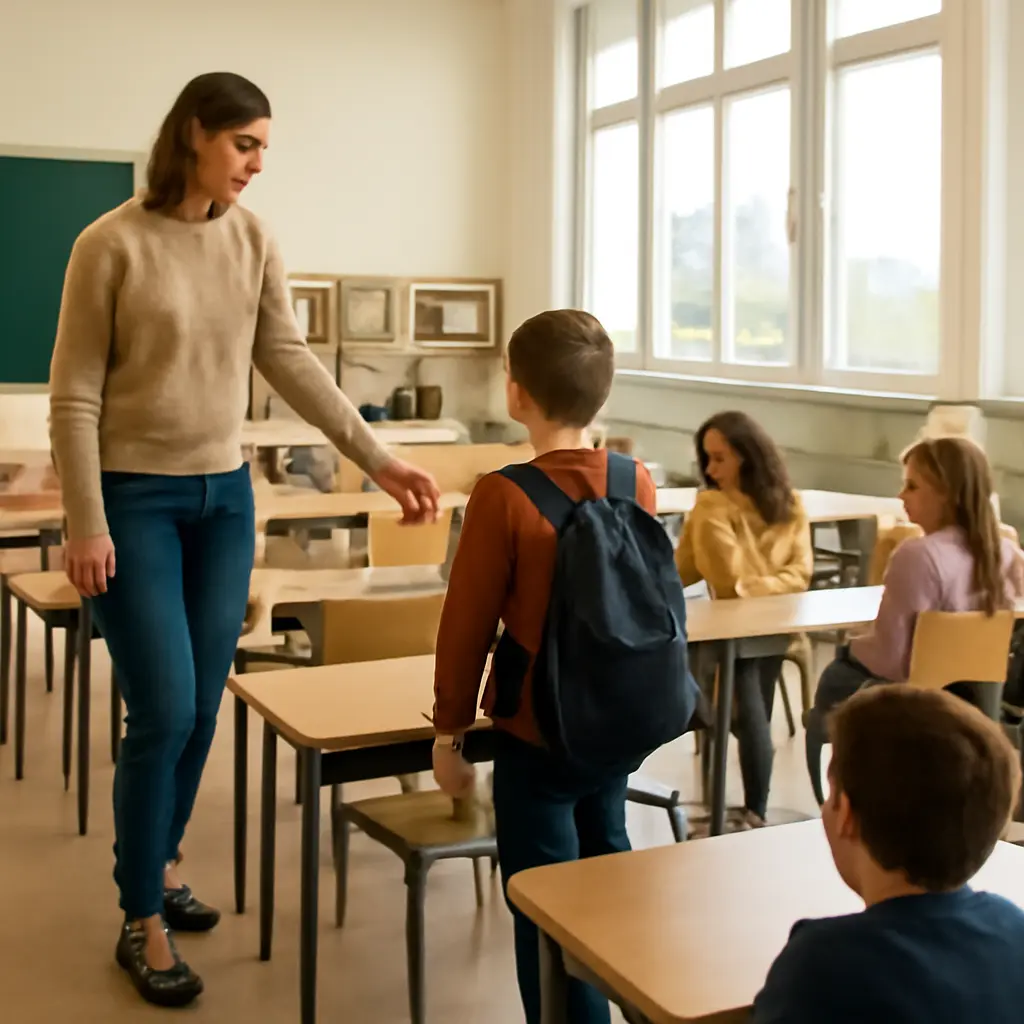
Compassionate courage in everyday kid moments is the ability to notice someone else’s difficulty and take a caring, age-appropriate action—even when speaking up, apologizing, or offering help feels uncomfortable. It can look like inviting a lonely classmate to play, telling an adult when teasing becomes harmful, or admitting “I’m sorry” after hurting a friend. These small acts connect empathy with brave behavior. They matter because children’s social and emotional skills are linked with later well-being and school success: a major meta-analysis of school-based social and emotional learning programs found improvements in social-emotional skills, attitudes, behavior, and academic performance, including an 11-percentile-point gain in achievement on average.
Compassionate Courage Defines Everyday Kid Moments
Compassionate courage is not a formal clinical diagnosis. It is a practical description of two capacities working together: compassion, or concern for another person’s well-being, and courage, or taking a helpful action despite fear, uncertainty, or social pressure. The Greater Good Science Center at the University of California, Berkeley, describes compassion as concern that arises when people perceive another’s suffering and feel motivated to help. In children’s daily lives, courage does not have to mean a dramatic rescue; it can be a small, safe choice that protects dignity or offers connection.
The idea has several related forms, or hyponyms: comforting courage, inclusion courage, truth-telling courage, repair courage, and help-seeking courage. Each combines awareness of another person’s needs with a suitable response. The Centers for Disease Control and Prevention identifies social and emotional skills—including managing emotions, setting goals, and maintaining supportive relationships—as important for children’s health and learning. Compassionate courage gives those broad skills a visible, everyday form.
Comforting courage
Comforting courage means noticing distress and offering gentle support without insisting on a particular response. A child might sit beside a disappointed teammate, ask “Do you want company?”, or get a trusted adult when a friend is hurt. The action is compassionate because it attends to the other child’s needs; it is courageous because reaching out can feel awkward or invite rejection. Adults can teach children to ask before touching or giving advice, since comfort should respect personal boundaries.
Inclusion courage
Inclusion courage is taking a modest social risk to help someone participate. It may mean making room at a lunch table, explaining the rules of a game, or inviting a new student to join. The U.S. Surgeon General’s advisory on youth mental health emphasizes that social connection supports health and well-being, while loneliness and isolation can be harmful. Inclusion is not a promise that every invitation will be accepted; it is a way to make belonging more accessible.
Truth-telling and help-seeking courage
Truth-telling courage means describing a problem honestly and respectfully, especially when someone is being excluded, bullied, or treated unfairly. Help-seeking courage means telling a trusted adult when a situation is unsafe or too difficult to handle alone. These actions are different from confronting a harmful person directly: children should not be expected to put themselves at risk. StopBullying.gov advises children who witness bullying to support the targeted person when safe and to involve a trusted adult. That guidance makes safety—not the performance of bravery—the measure of a good choice.
Repair courage
Repair courage is the willingness to acknowledge harm, apologize sincerely, and try to make things right. A meaningful apology names what happened, recognizes its effect, and offers a realistic repair rather than demanding immediate forgiveness. For example, a child who knocks over a classmate’s blocks might say, “I knocked them down. I’m sorry. Can I help rebuild?” Repair teaches responsibility while keeping attention on the person affected.
Compassionate Courage Grows Through Everyday Practice
These forms of courage become more possible when children can identify feelings, imagine another person’s perspective, and choose among safe responses. They do not develop through pressure to be fearless. Instead, children benefit from adults who model caring action, make room for mistakes, and praise thoughtful effort rather than labeling a child “a hero.” A contextual bridge connects feeling to action: first notice what is happening, then consider what the other person may need, and finally choose a safe response.
Emotional literacy makes caring visible
Emotional literacy is the ability to recognize and name feelings in oneself and others. Naming a feeling—“She looks left out” or “I’m nervous about asking”—can help a child pause before reacting. The Collaborative for Academic, Social, and Emotional Learning (CASEL) includes self-awareness, social awareness, relationship skills, and responsible decision-making among its core social and emotional learning competencies. These connected skills give children language for compassion and a framework for choosing a response.
Small scripts lower the social risk
A simple phrase can make a brave action easier to start. Caregivers and teachers can practice options such as “Want to play with us?”, “That doesn’t seem fair,” “Are you okay?”, and “I need help.” Role-play can also include what to do if the first attempt does not work: try another welcoming action, give the person space, or find an adult. A 2011 meta-analysis by Joseph Durlak and colleagues examined 213 universal school-based social and emotional learning programs involving more than 270,000 students. It reported improvements in social-emotional skills, attitudes, behavior, and academic performance, with achievement gains averaging 11 percentile points. The finding supports intentional skill-building, though it does not mean one specific phrase or exercise will produce the same result for every child.
Adult modeling turns values into examples
Children learn what compassionate courage looks like by seeing adults respond to everyday problems. An adult might calmly interrupt a hurtful joke, check on someone who has been excluded, or admit, “I spoke too sharply; I’m sorry.” Such examples show that courage can be steady rather than loud and that repair is possible after a mistake. The National Academies of Sciences, Engineering, and Medicine has highlighted the importance of supportive relationships and environments in child development; consistent adult responses help make those relationships a practical setting for learning.
Safe choices matter more than dramatic gestures
Compassionate courage should be proportionate to a child’s age, abilities, and the situation. If someone is in immediate danger, a child’s best action may be to get a responsible adult rather than intervene physically. If a peer declines comfort, respecting that boundary can itself be caring. Adults can reinforce the principle with a simple sequence: notice, ask, act safely, and seek help when needed. This keeps compassion from becoming pressure to solve every problem or carry responsibility that belongs to adults.
Compassionate Courage Appears in Real Kid Moments
A playground, classroom, team, or family gathering can provide a practical case study in how these skills work together. Imagine a child who sees a classmate standing alone after arriving late to a game. The child could notice the classmate’s isolation, ask whether they want to join, explain how the game works, and accept the answer without making a scene. If the classmate is being mocked, the child could instead support them and alert a teacher. The right action depends on context, but the guiding aim remains the same: protect safety and dignity while offering a genuine path to connection.
A simple chart can help families or educators reflect after such moments:
- Notice: What did the child see or hear?
- Care: What might the other person be feeling or needing?
- Choose: What safe, respectful action was available?
- Reflect: What happened next, and what could the child try another time?
This is a reflection tool, not a test of a child’s character. Children may freeze, miss a cue, or need adult help; those moments are opportunities to practice rather than reasons for shame. Adults can ask curious questions—“What did you notice?” and “What might help?”—instead of demanding that a child always know exactly what to do.
Conclusion: Compassionate Courage Starts Small
Compassionate courage brings together concern for others and the willingness to act thoughtfully despite discomfort. Its everyday forms include comforting someone, making room, telling the truth safely, asking an adult for help, and repairing harm. Research on social and emotional learning supports teaching the skills behind these moments, while guidance on youth connection and bullying underscores the importance of belonging and safe intervention. Families and educators can help by modeling caring behavior, practicing simple scripts, respecting boundaries, and praising effort rather than demanding fearlessness. For further learning, explore the social and emotional learning resources from CASEL and the National Academies, and look for one small opportunity this week to notice, connect, or seek help.
Sources: Greater Good Science Center, University of California, Berkeley, “Compassion,” https://greatergood.berkeley.edu/topic/compassion/definition; Centers for Disease Control and Prevention, “Promoting Mental Health and Well-Being in Schools,” https://www.cdc.gov/mental-health-action-guide/about/index.html; U.S. Surgeon General, Our Epidemic of Loneliness and Isolation: The U.S. Surgeon General’s Advisory on the Healing Effects of Social Connection and Community, 2023, https://www.hhs.gov/sites/default/files/surgeon-general-social-connection-advisory.pdf; StopBullying.gov, “How to Respond to Bullying,” https://www.stopbullying.gov/prevention/how-to-prevent-bullying; Collaborative for Academic, Social, and Emotional Learning (CASEL), “What Is the CASEL Framework?,” https://casel.org/fundamentals-of-sel/what-is-the-casel-framework/; Durlak, Joseph A., et al., “The Impact of Enhancing Students’ Social and Emotional Learning: A Meta-Analysis of School-Based Universal Interventions,” Child Development, 2011, https://doi.org/10.1111/j.1467-8624.2010.01564.x; National Academies of Sciences, Engineering, and Medicine, The Promise of Adolescence: Realizing Opportunity for All Youth, 2019, https://doi.org/10.17226/25388.