
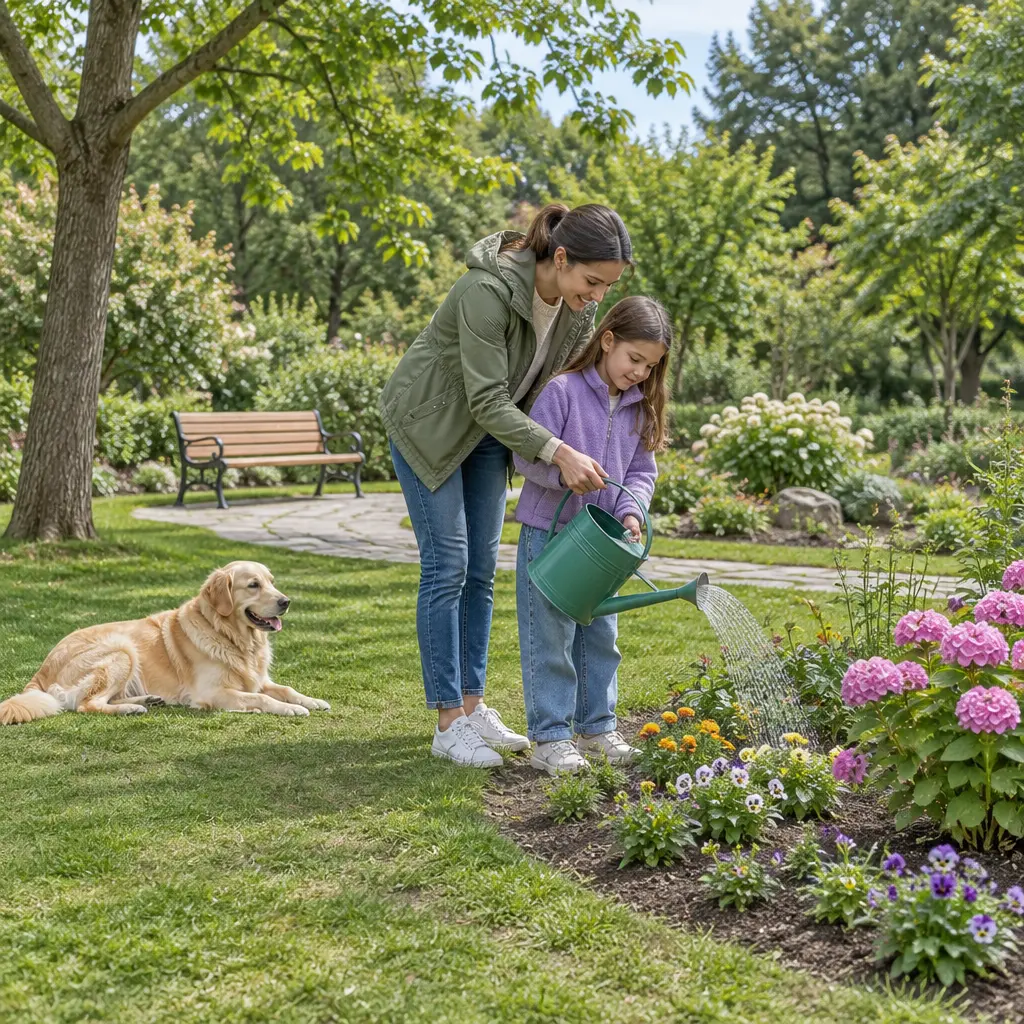
Pets and nature can deepen a child’s compassion by giving them regular, concrete chances to notice another living being’s needs and respond with care. Compassion combines awareness of someone else’s feelings with a motivation to help; children can practice it while gently caring for an animal, observing wildlife without disturbing it, or tending a garden. Research links positive human–animal interactions with children’s social and emotional development, while nature experiences can encourage perspective-taking and care for living things. These benefits depend on adult guidance, safe interactions, and respect for animals’ needs—not simply on having a pet or spending time outdoors.
How Pets and Nature Can Build Compassion in Children
Compassion is more than feeling sorry for someone: it involves recognizing distress or need and choosing a considerate response. Pets and the natural world make that process visible. A child may learn that a dog needs space, that a bird should be watched quietly, or that a plant needs water rather than being pulled from the soil. These everyday moments connect empathy with responsible action.
The topic matters because children develop social understanding through relationships and repeated practice. The American Academy of Pediatrics describes play as important to healthy development, including social-emotional learning. The National Institute of Child Health and Human Development’s Study of Early Child Care and Youth Development followed more than 1,000 children, illustrating the scale of research into how early environments relate to development; it does not, however, establish that pet ownership alone causes compassion. The strongest approach is to combine warm adult modeling with safe, age-appropriate responsibilities and opportunities to observe nature.
How Compassion Develops Through Pets and Nature
Compassion develops through noticing, understanding, and responding. In its guidance on social and emotional learning, the Collaborative for Academic, Social, and Emotional Learning (CASEL) identifies social awareness as the ability to understand others’ perspectives and show empathy. Applied to animals and nature, this means helping a child recognize cues, consider what a living thing may need, and act in a way that protects its well-being.
Empathy and perspective-taking
Empathy is the ability to understand or share another’s emotional state; perspective-taking is the related effort to consider a situation from another point of view. A child who sees a pet retreating can be guided to understand that the animal may want quiet, rather than interpreting the retreat as rejection. Adults can make the lesson concrete by asking, “What is the animal showing us?” and “What would help it feel safe?”
A 2015 review by James A. Serpell in the journal Applied Developmental Science examined research on children and companion animals, noting potential links between human–animal interaction and social-emotional development while also emphasizing that findings vary with the child, animal, and context. The practical takeaway is measured: animals can provide opportunities to practice empathy, but they are not a guaranteed treatment or a substitute for supportive relationships with people.
Responsibility and caregiving
Caregiving is a set of actions that meets another living being’s needs. With adult supervision, children can help refill a water bowl, brush an animal gently, or check whether a garden needs watering. These routines teach that care is consistent: it involves noticing needs and following through, not just enjoying a cute or exciting moment.
Responsibilities should fit a child’s age and abilities. Adults remain accountable for feeding, veterinary care, hygiene, and safety; a child’s participation should be supervised and optional rather than treated as a replacement for adult care. The American Veterinary Medical Association advises families to consider a pet’s welfare and suitability before bringing an animal home. This helps children learn that compassion includes making responsible choices before taking on a commitment.
Kindness, boundaries, and respect
Kindness toward animals includes respecting boundaries. Children should learn to ask permission before approaching a companion animal, avoid disturbing an animal that is eating or sleeping, and stop when it shows signs of discomfort. The Humane Society of the United States recommends teaching children safe, calm interactions and supervising contact, especially with unfamiliar animals.
The same principle applies outdoors. Watching wildlife from a distance, leaving nests and dens undisturbed, and staying on designated paths help children understand that care sometimes means not touching or intervening. This links compassion with self-control and respect for another living being’s space.
How Pets Create Everyday Opportunities to Practice Compassion
Pets make care visible through familiar routines and communication cues. Their needs can prompt conversation about comfort, trust, and responsibility. Because animals cannot explain their feelings in words, children benefit when adults help interpret behavior cautiously rather than assuming that every action has a simple human equivalent.
Reading animal cues
Reading cues means observing an animal’s posture, movement, and behavior to decide whether it appears relaxed, interested, fearful, or uncomfortable. A relaxed animal may approach voluntarily; turning away, hiding, growling, or trying to escape can signal that it needs space. The American Veterinary Medical Association’s guidance on dog bite prevention stresses teaching children to behave calmly around dogs and not to approach unfamiliar or unsupervised animals.
Adults can narrate observations without claiming certainty: “The cat moved away, so let’s give it room.” This supports careful attention and shows that compassion requires listening to signals, even when they are nonverbal.
Shared routines and dependable care
A shared routine—such as preparing a pet’s food with an adult or helping clean an enclosure—turns concern into dependable action. The Centers for Disease Control and Prevention recommends handwashing after handling animals, their food, or their environments, and advises adults to supervise children around animals. These practices connect compassion with hygiene and public health: caring for an animal also means protecting people and keeping the animal’s environment clean.
Families without pets can still teach the same skills through supervised visits to a reputable animal shelter, a farm education program, or a friend’s home. Participation should always follow the animal’s comfort and the organization’s safety rules.
How Nature Encourages Compassion for Living Things
Nature offers children opportunities to observe life beyond the family home. A garden, park, or patch of sidewalk can reveal that plants and animals have different needs and that people’s actions affect shared habitats. The National Wildlife Federation’s Green Hour initiative encourages outdoor time and nature-based exploration; its activities provide practical ways for families and educators to make observation part of everyday life.
Wildlife observation and perspective
Wildlife observation is the practice of watching animals in their habitats without disrupting them. Children can look for tracks, listen for birds, or observe insects from a respectful distance. The National Park Service’s “Leave No Trace” principles emphasize minimizing disturbance and leaving natural objects where they are. These guidelines turn curiosity into a lesson in restraint: an animal’s needs come before a visitor’s desire to touch or collect.
A simple activity is to watch one small area quietly for several minutes and record what changes. Adults can ask what the animal might need to stay safe and which human actions could disturb it. The discussion helps children connect observation with perspective-taking without pretending to know exactly what an animal feels.
Gardening and care for plants
Gardening teaches care through patience and attention to living systems. Children can plant seeds, water them appropriately, and notice how sunlight and soil affect growth. The United States Department of Agriculture’s National Agricultural Library explains that school gardens can support hands-on learning across subjects; garden activities also offer a practical setting to discuss how plants, insects, soil, and people are connected.
A garden need not be large. A pot of herbs or a few native flowers can give children a regular reason to observe change and consider the needs of other species. Adults can encourage gentle stewardship, such as leaving some flowers for pollinators and avoiding unnecessary harm to insects.
Outdoor play, cooperation, and stewardship
Outdoor play can create shared challenges that call for cooperation: building a shelter from fallen sticks, exploring a trail together, or helping clean up litter in an appropriate supervised activity. The American Academy of Pediatrics’ clinical report on the power of play describes play as supporting social and emotional development, among other areas. Nature-based play can add a stewardship dimension when adults help children notice how their choices affect a place.
A useful distinction is between caring for nature and treating it as a prop. Children can enjoy outdoor spaces while learning to avoid damaging plants, disturbing wildlife, or leaving trash behind. This broadens compassion from individual animals to habitats and communities.
How Adults Can Nurture Compassion Safely
Adults shape these experiences by modeling calm behavior, naming needs, and setting clear boundaries. A child is more likely to learn from a consistent example than from a lecture alone. The goal is not to require a particular emotional response, but to help children notice living things and choose respectful actions.
Use questions that invite observation
Open-ended questions help children think rather than guess what an adult wants to hear. Try asking, “What do you notice?”, “What might this animal need?”, or “How can we give it space?” For a plant or habitat, ask what has changed and what might help it thrive. When a child is unsure, adults can offer information while acknowledging uncertainty.
Match activities to age and ability
Young children can help with simple supervised tasks, such as carrying a small watering can or observing an animal from a safe distance. Older children may be ready to keep a garden journal, learn signs of animal stress, or take part in a supervised habitat project. Development, temperament, allergies, disability, and family circumstances all matter; there is no single activity that suits every child.
Keep safety and animal welfare central
Compassionate learning must protect both children and animals. The CDC advises adults to supervise children around animals, wash hands after contact, and seek guidance about risks such as bites, scratches, and germs. Families should consult a pediatrician or veterinarian when they have concerns about allergies, infection risks, or an animal’s health. Wild animals should not be handled, and children should not be left alone with pets.
Conclusion: Compassion Grows Through Attention and Care
Pets and nature can help children practice empathy, responsibility, kindness, and respect for boundaries. Pets make daily needs and communication cues visible; wildlife observation, gardening, and outdoor play extend care to plants, animals, and shared habitats. Research and guidance from pediatric, veterinary, public-health, and conservation organizations support the value of safe, guided experiences, while reminding families that no pet or outdoor activity guarantees a particular developmental outcome.
Start small: observe a bird without approaching, grow a plant together, or help with one supervised pet-care routine. Ask children what they notice, model gentle behavior, and make safety and the living being’s needs the priority. These repeated acts of attention can help compassion become a practical habit that reaches beyond animals and nature into relationships with other people.
Sources: Collaborative for Academic, Social, and Emotional Learning, What Is the CASEL Framework?, https://casel.org/fundamentals-of-sel/what-is-the-casel-framework/; Serpell, James A., “Animal-Assisted Interventions in Historical Perspective,” Applied Developmental Science, 2015, https://doi.org/10.1080/10888691.2015.1027781; American Academy of Pediatrics, “The Power of Play: A Pediatric Role in Enhancing Development in Young Children,” Pediatrics, 2018, https://doi.org/10.1542/peds.2018-2058; American Veterinary Medical Association, “Selecting a Pet,” https://www.avma.org/resources-tools/pet-owners/selecting-pet; Humane Society of the United States, “Kids and Dogs,” https://www.humanesociety.org/resources/kids-and-dogs; American Veterinary Medical Association, “Dog Bite Prevention,” https://www.avma.org/resources-tools/pet-owners/dog-bite-prevention; Centers for Disease Control and Prevention, “Healthy Pets, Healthy People: Healthy Habits,” https://www.cdc.gov/healthy-pets/about/healthy-habits.html; National Wildlife Federation, “Green Hour,” https://www.nwf.org/Generational-Programs/Green-Hour; National Park Service, “Leave No Trace Seven Principles,” https://www.nps.gov/articles/leave-no-trace-seven-principles.htm; United States Department of Agriculture, National Agricultural Library, “School Gardens,” https://www.nal.usda.gov/collections/stories/school-gardens; National Institute of Child Health and Human Development, “Study of Early Child Care and Youth Development,” https://www.nichd.nih.gov/research/supported/seccyd.