
Inclusive Upbringing and Leadership: How Childhood Experiences Build Skills for a Diverse World
An inclusive upbringing is one in which children are encouraged to respect differences, participate fairly, and form relationships across lines of identity and ability. It does not guarantee that a child will become a strong leader, but research on perspective-taking, empathy, and cooperative learning helps explain why these experiences can build useful leadership capacities. Children who practice listening to different viewpoints, sharing influence, and addressing exclusion get early experience with skills leaders need: communication, sound judgment, collaboration, and trust-building. This article explains what inclusive upbringing means, how its core practices relate to leadership, what the evidence can—and cannot—establish, and how families and schools can put inclusion into practice.
Inclusive Upbringing Builds Leadership Through Everyday Social Learning
Inclusive upbringing describes a pattern of family, school, and community experiences that treats children as valued participants while helping them recognize and respect people’s different backgrounds, needs, and perspectives. It includes more than teaching tolerance: children also need opportunities to cooperate, make choices, and notice whose voices are missing. UNICEF’s Convention on the Rights of the Child establishes children’s rights to express views on matters affecting them and to have those views considered according to their age and maturity. That principle connects inclusion with a practical leadership lesson: participation requires listening as well as speaking.
The connection is developmental, not deterministic. A child’s temperament, opportunities, education, and later experiences also shape leadership. Still, inclusive settings can give children repeated practice with social skills that matter in groups. The Collaborative for Academic, Social, and Emotional Learning (CASEL) identifies relationship skills, social awareness, and responsible decision-making among the core areas of social and emotional learning. These are closely related to how effective leaders work with people, resolve disagreements, and make choices that account for others.
Inclusion Means Belonging, Participation, and Fairness
Inclusion is the active creation of conditions in which people can participate and feel they belong, rather than simply being present in the same room. In education, UNESCO’s work on inclusive education emphasizes responding to learners’ diverse needs and removing barriers to participation. For children, that may mean adapting an activity so a classmate with a disability can take part, making room for quieter students’ ideas, or questioning a stereotype without humiliating someone.
These experiences introduce several related forms of inclusion: cultural inclusion, disability inclusion, gender inclusion, and social inclusion across differences in language, income, or family background. The settings differ, but the leadership practice is similar: identify barriers, seek input from those affected, and adjust the group’s approach. Inclusion is not a promise that everyone will agree; it is a way to ensure people are treated with dignity and can contribute meaningfully.
Leadership Is Influence Used Toward Shared Goals
Leadership is the process of influencing and coordinating people toward a shared purpose. It can be formal, as when a student is elected class representative, or informal, as when a child helps a group settle on fair rules. Inclusive upbringing can support both forms by helping children understand that leadership is not simply command or visibility. It also involves responsibility, accountability, and attention to how decisions affect others.
The distinction matters because no single upbringing style can promise future leadership success. Research on social and emotional learning supports the value of teachable interpersonal competencies, but it does not prove that inclusion alone causes children to become better leaders as adults. A more careful conclusion is that inclusive experiences offer useful practice in capabilities that leadership often requires.
Inclusive Upbringing Strengthens Empathy and Perspective-Taking
Empathy is the ability to understand or respond to another person’s feelings and perspective. Perspective-taking is the related skill of considering how a situation may look to someone whose experiences differ from one’s own. In leadership, these abilities help people understand team concerns, communicate decisions with care, and notice when a policy or routine works for some people but excludes others.
Developmental research suggests that children can learn these skills through guided interaction, discussion, and cooperative activity. They are not automatic outcomes of exposure to difference: adults also need to model respectful curiosity and help children reflect on what happened. When a child hears a classmate explain why a game’s rules leave them out, for example, the group can consider the impact and redesign the activity together.
Empathy Helps Leaders Understand People Before Acting
Empathy supports leadership by encouraging attention to people’s needs before decisions are made. It can help a child who is leading a group notice that one teammate is confused, left out, or hesitant to speak. In adulthood, the same habit can make a manager more attentive to staff experiences or help a community organizer design a meeting that works for more residents.
The World Health Organization’s work on social and emotional learning recognizes interpersonal competencies as relevant to well-being and healthy relationships. That supports teaching empathy as a useful life skill, while not establishing that empathy by itself produces effective leadership. Leaders also need judgment, knowledge, and the ability to make difficult decisions fairly.
Perspective-Taking Improves Decisions in Diverse Groups
Perspective-taking means deliberately considering another person’s viewpoint rather than assuming one’s own experience is universal. Children can practice it by comparing how different classmates experience the same classroom rule or by discussing whose needs a proposed solution meets. That habit can translate into more careful group decisions: leaders are better equipped to ask who benefits, who bears a cost, and what information is still missing.
A frequently cited 2011 meta-analysis by David W. Johnson and Roger T. Johnson examined 148 studies involving more than 17,000 early adolescents. It found that cooperative learning was associated with stronger relationships among students than competitive or individualistic approaches. The finding supports the value of structured cooperation for peer relationships; it should not be mistaken for direct proof that inclusive childhood experiences create adult leaders.
Inclusive Upbringing Develops Collaboration and Conflict Resolution
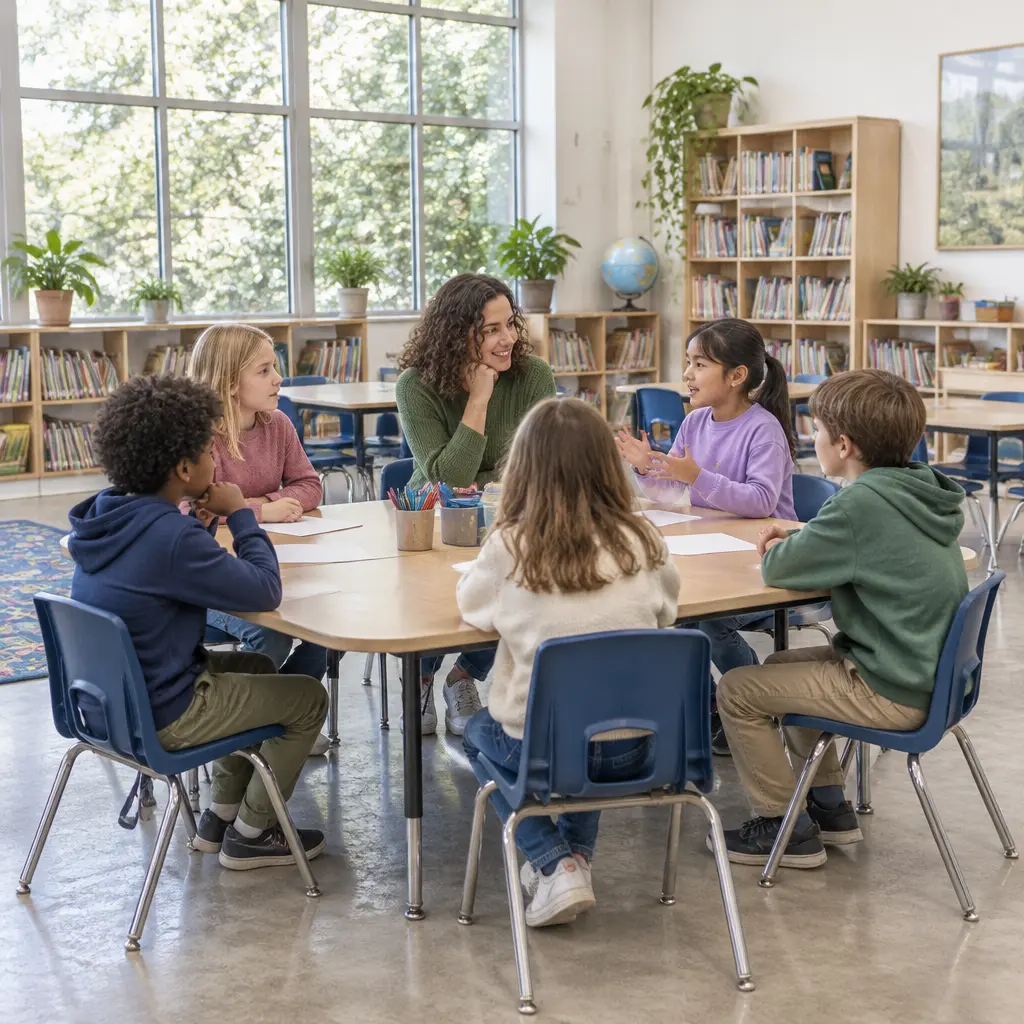
Collaboration is the ability to work with others toward a shared result while contributing, coordinating, and responding to feedback. Children develop it when activities require interdependence rather than simply placing students side by side. Inclusive group work gives children opportunities to divide roles fairly, adapt communication, and recognize contributions that may be less visible than speaking first or finishing fastest.
These experiences connect naturally to conflict resolution. Disagreement is common in groups; leadership involves addressing it without ignoring harm or treating every dispute as a contest to win. Adults can teach children to describe a problem, listen to each person involved, identify shared interests, and agree on a next step. This approach provides practice in both cooperation and accountability.
Cooperative Learning Makes Shared Responsibility Visible
Cooperative learning is structured group learning in which students work toward common goals and each person has a meaningful role. The Education Endowment Foundation’s Teaching and Learning Toolkit reports that collaborative learning approaches can have a positive average effect on academic outcomes, while noting that results depend on how activities are designed. Groups work best when participation is purposeful and students are not left to assume that one confident member will do everything.
For leadership development, the key lesson is shared responsibility. A child who takes turns facilitating, summarizing ideas, or checking that everyone has a role learns that group success depends on coordination, not just individual performance. Adults can strengthen this lesson by rotating roles and recognizing listening, planning, and support alongside visible presentation skills.
Conflict Resolution Teaches Fairness and Accountability
Conflict resolution is the process of addressing disagreement, repairing harm where appropriate, and finding a workable path forward. Inclusive approaches discourage dismissing a concern simply because it comes from a less powerful person. They also distinguish between a minor disagreement and behavior that requires adult intervention, protection, or formal safeguarding.
Children can learn a simple sequence: pause, hear each person’s account, name the impact, consider fair options, and check whether the agreement is working. This is not a substitute for adult responsibility when there is bullying, discrimination, or a safety risk. It does, however, give children a foundation for handling ordinary disagreements respectfully and for seeking help when a problem exceeds their ability to resolve it.
Inclusive Upbringing Encourages Ethical and Adaptive Leadership
Ethical leadership involves making decisions with attention to fairness, responsibility, and the effects on others. Adaptive leadership involves learning and adjusting when circumstances change or familiar solutions do not work. Inclusive childhood experiences can support both by encouraging children to ask questions, consider different needs, and revise a plan when new information appears.
These qualities matter in a changing society. The U.S. Census Bureau reported that 13.9% of the U.S. population was foreign-born in 2022, and the country’s communities include many languages, cultures, and family structures. That figure describes population diversity, not the leadership effects of inclusive upbringing. It does, however, underline why the ability to communicate across differences is relevant in schools, workplaces, and civic life.
Fairness Helps Leaders Build Trust
Fairness means applying principles consistently while recognizing that people may need different kinds of support to participate. Treating everyone identically is not always equitable: a child who needs an accessible format may require a different tool to have the same opportunity to contribute. Leaders who understand this distinction can make more credible decisions and explain why adjustments are appropriate.
In childhood, fairness can be practiced through turn-taking, transparent group rules, and discussion about whether everyone had a genuine chance to participate. These habits do not remove bias, but they give children a vocabulary for identifying unequal treatment and a process for reconsidering it. In later leadership settings, consistency and openness can help sustain trust.
Adaptability Helps Leaders Respond to Change
Adaptability is the capacity to adjust one’s approach when conditions, evidence, or people’s needs change. Inclusive groups often need to adapt communication or procedures so that more members can participate. A child who helps modify a game for a classmate or changes a presentation after receiving feedback learns that revising a plan can be a sign of good judgment rather than failure.
This skill pairs with humility: effective leaders must be willing to discover that their first assumption was incomplete. Adults can support this by asking children what they learned from a decision, whose perspective changed their thinking, and what they would do differently next time. Reflection turns an experience into a transferable leadership practice.
Inclusive Upbringing Can Be Put Into Practice at Home and School
Inclusion becomes meaningful through repeated actions, not slogans. Families, educators, and community leaders can create ordinary opportunities for children to practice listening, shared decision-making, and respectful disagreement. The aim is not to make children responsible for solving systemic problems on their own; it is to help them participate thoughtfully while adults remain accountable for safe and equitable environments.
Model Respectful Curiosity and Correct Stereotypes
Adults can model curiosity by asking about experiences without treating one child as a spokesperson for an entire group. When a stereotype or exclusionary remark occurs, respond calmly and clearly: name why it is unfair, correct misinformation, and guide the child toward a respectful alternative. Children learn from how adults handle mistakes as much as from formal lessons.
Give Children Real, Supported Choices
Meaningful participation means children can influence decisions suited to their age and responsibilities. Invite them to help set group norms, choose among project options, or suggest ways to make an activity accessible. Adults should explain which decisions are open to change and which are constrained by safety or practical requirements; honest boundaries make participation more credible.
Measure Participation, Not Just Good Intentions
Families and schools can check whether inclusion is working by noticing who speaks, who receives meaningful roles, who is interrupted, and who is left out. A classroom can use rotating responsibilities or brief reflection prompts to make participation patterns visible. These observations are more informative than assuming an activity is inclusive simply because no one has complained.
A text-based comparison chart could track the skills discussed here: inclusive practice, the child’s opportunity to practice it, and its related leadership capability. For example, shared group roles connect to coordination; listening across differences connects to perspective-taking; and revising a group rule connects to adaptability. Such a chart would illustrate pathways for practice, not measure or predict a child’s future leadership ability.
Conclusion: Inclusive Upbringing Gives Future Leaders More Ways to Listen and Lead
Inclusive upbringing can help children practice empathy, perspective-taking, collaboration, conflict resolution, fairness, and adaptability. These skills are relevant to leadership because they help people understand a group, make considered decisions, and build conditions in which others can contribute. Research on cooperative learning and social-emotional competencies supports the value of these skills, but it does not establish that inclusion alone causes leadership success.
The practical implication is straightforward: adults can model respect, make participation genuine, and give children supported opportunities to work across differences. Families and schools can begin by reviewing whose voices are heard and who is able to take part. Further reading from UNICEF, UNESCO, and CASEL can help turn those intentions into developmentally appropriate practices.
Sources: UNICEF, Convention on the Rights of the Child, https://www.unicef.org/child-rights-convention/convention-text; Collaborative for Academic, Social, and Emotional Learning (CASEL), What Is the CASEL Framework?, https://casel.org/fundamentals-of-sel/what-is-the-casel-framework/; UNESCO, Inclusion in Education, https://www.unesco.org/en/inclusion-education; Johnson, D. W. and Johnson, R. T., “Intellectual and Personal Development Through Cooperative Learning,” 2011, https://doi.org/10.3102/0013189X11400151; Education Endowment Foundation, Collaborative Learning Approaches, https://educationendowmentfoundation.org.uk/education-evidence/teaching-learning-toolkit/collaborative-learning-approaches; World Health Organization, Skills for Health: Skills-Based Health Education Including Life Skills, https://www.who.int/publications/i/item/9789240004243; U.S. Census Bureau, “Foreign-Born Population in the United States: 2022,” https://www.census.gov/library/stories/2023/12/foreign-born-population-growth.html.