
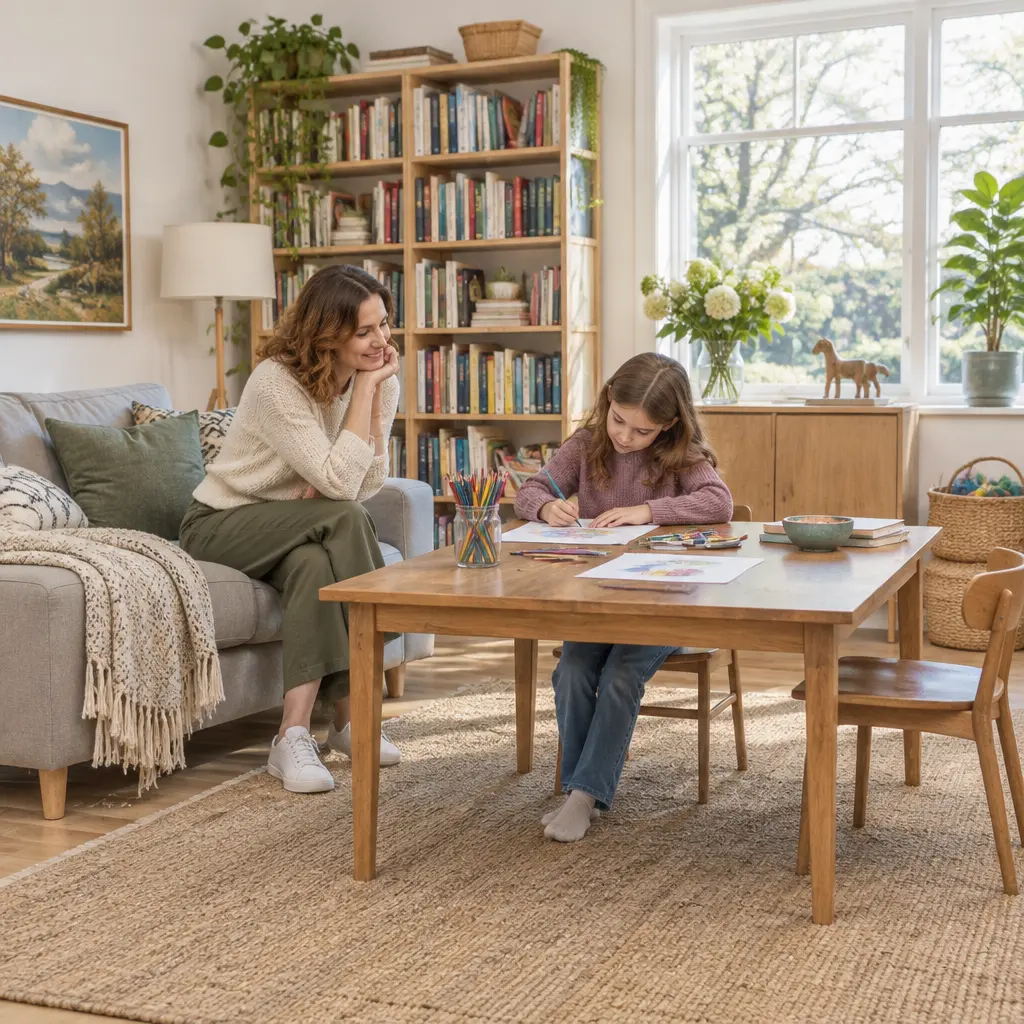
A child’s interests are the activities, questions, and subjects they choose to explore—not a fixed measure of talent or a forecast of their future. Supporting those interests without judgment means offering encouragement, resources, and safe boundaries while letting the child’s preferences guide participation. This approach matters because autonomy and supportive relationships are associated with children’s motivation and well-being. The American Academy of Pediatrics recommends following children’s cues in play, while research on self-determination emphasizes autonomy, competence, and connection. The sections below explain what nonjudgmental support looks like, how to respond to changing or unexpected interests, and how to balance a child’s choices with practical limits.
Nonjudgmental support strengthens children’s interest-led exploration
Nonjudgmental support is a parenting approach that treats a child’s interests with curiosity and respect rather than ranking them as impressive, embarrassing, useful, or unsuitable. It does not mean agreeing to every request or removing all guidance. It means separating the child’s worth from their choices and responding without ridicule, shame, or pressure to perform.
The American Academy of Pediatrics’ clinical report on play describes play as important to children’s development and encourages adults to follow a child’s lead during child-directed play. Psychologists Edward Deci and Richard Ryan’s self-determination theory identifies autonomy, competence, and relatedness as basic psychological needs. Together, these ideas suggest that children benefit when they can make age-appropriate choices, try skills at their own pace, and feel connected to supportive adults.
Interest-led exploration can include hobbies, pretend play, collections, questions, creative projects, and changing preferences. A child may be drawn to insects, dance, building, fashion, sports, or a subject adults did not expect. The goal is not to turn every interest into a lesson or achievement, but to make room for safe exploration and discovery.
Autonomy: Let children have meaningful choices
Autonomy is a child’s experience of having some ownership over what they do and how they do it. It is not the same as having no rules. Parents can offer a small set of acceptable options—for example, choosing between drawing, reading, or going outside—while keeping necessary limits around safety, schedules, and family resources.
A systematic review and meta-analysis by Vasquez and colleagues examined parental autonomy support and children’s academic achievement, engagement, and psychological well-being. The findings support an association between autonomy-supportive parenting and positive outcomes, though associations do not prove that one parenting behavior alone causes them. In everyday life, autonomy support can be as simple as asking, “Which part would you like to try first?” rather than taking over.
Competence: Value practice over praise for being “gifted”
Competence is the sense that effort can help a person learn and improve. A child who enjoys drawing, chess, gardening, or basketball may need time to experiment without being evaluated at every step. Specific observations—“You tried three ways to make that stand”—recognize effort and strategy without making affection depend on success.
The American Psychological Association’s guidance on praise cautions that labels focused only on innate ability can make setbacks feel threatening. Parents can instead show interest in the process, ask what the child noticed, and allow frustration without rushing to fix it. This keeps an activity open to learning rather than turning it into a test of talent.
Relatedness: Make acceptance visible
Relatedness is the feeling of being cared for and accepted. A parent does not need to share a child’s enthusiasm to communicate respect. Listening, learning the name of a favorite character, attending a practice when possible, or displaying a project at home can tell a child, “Your enjoyment matters to me.”
This support is especially important when a child’s interest conflicts with stereotypes about gender, culture, ability, or social status. Adults can avoid dismissive comments and help children find welcoming, age-appropriate spaces in which to participate. Respect does not require pretending to know everything; genuine questions are often more supportive than quick judgments.
Parents can respond to children’s interests with curiosity and practical support
Once adults understand that interests can support autonomy, learning, and connection, the next step is deciding how to respond. A useful pattern is to notice the interest, ask what the child enjoys about it, and offer an appropriate way to explore it. This works whether the interest is longstanding, newly discovered, or different from what the family expected.
Ask open questions instead of evaluating
Open questions invite a child to explain their experience without requiring them to defend it. Try “What do you like about that?” or “What would you like to find out next?” Avoid turning every conversation into a quiz about usefulness, future careers, or whether the activity is “good enough.”
Reflective listening is also useful: “You seem excited when you talk about the aquarium.” This acknowledges the child’s feeling without pretending that the adult shares the same passion. If the child does not want to talk, allow space rather than treating silence as rejection.
Offer access without demanding commitment
Support can be modest and low-pressure: borrow a book from the library, visit a free community event, reuse household materials for a project, or try a short class before signing up for a full season. The National Endowment for the Arts’ research on arts participation documents that children encounter arts through multiple settings, including school, community programs, and the home. Families do not need expensive equipment or formal lessons to encourage creative exploration.
A child may discover that an activity is not enjoyable after trying it. That is useful information, not evidence of laziness or failure. Before making a major purchase or long-term commitment, families can agree on a trial period and revisit the decision together.
Make room for changing interests
Children’s interests often shift as their skills, friendships, and experiences change. A child might move from dinosaurs to drawing maps, or stop playing a sport they once loved. Unless there is a specific obligation or safety concern, adults can treat these changes as part of exploration rather than accuse the child of being inconsistent.
When a child wants to quit an ongoing activity, listen first and distinguish between ordinary difficulty, loss of interest, social problems, and a potentially unsafe environment. Then discuss reasonable commitments—for instance, finishing a short session or speaking with a coach—without using guilt or threats to force enthusiasm.
Boundaries protect children without judging their preferences
Respecting a child’s interests does not require unlimited spending, screen time, or access to risky activities. A boundary focuses on what the family can safely or realistically provide; judgment attacks the child for wanting something. “We can’t buy that right now, but we can look for a library copy” preserves dignity while setting a clear limit.
Set limits around safety, time, and family resources
Explain limits plainly and, when possible, offer an alternative. For example: “You can use the tools with me beside you,” or “We have time for one activity this term; let’s compare the options.” Clear expectations help children understand that a limit is about safety or logistics, not a verdict on whether their interest is worthwhile.
For online interests, the American Academy of Pediatrics’ Family Media Plan encourages families to consider screen use alongside sleep, physical activity, schoolwork, and relationships. Parents can set developmentally appropriate rules about privacy, content, and device time while showing curiosity about what a child enjoys online. If an activity involves physical risk, supervision and instruction should match the child’s age and ability.
Notice when outside pressure is shaping your reaction
Adults may judge an interest because of their own expectations: a wish for high achievement, concern about social approval, or beliefs about what “boys” or “girls” should like. Pausing before responding can help. Ask yourself whether the concern is about a real safety or practical issue, or whether the activity simply differs from what you imagined for your child.
If relatives or peers make dismissive remarks, calmly restate the family’s approach: “We’re letting them explore what they enjoy.” Children notice whether adults defend their dignity, particularly when an interest is unconventional or not widely understood.
Everyday examples show what nonjudgmental support looks like
Consider a child who spends weeks collecting rocks. Instead of calling the collection pointless, a parent might ask where the child found each rock, help identify them using a library resource, and agree on a safe place to store them. The adult supports curiosity without insisting that the hobby become a science project.
Or imagine a child who wants to try dance even though the family expected them to choose soccer. A supportive response is to discuss class schedules, cost, and transportation, then look for a feasible trial class. If the child later decides dance is not for them, the family can talk about what they learned rather than framing the change as a failure.
These examples illustrate a practical distinction: adults remain responsible for guidance, but children can have a meaningful voice in what captures their attention. The outcome is not guaranteed to be a lasting hobby or measurable achievement. It may simply be a child who feels safe sharing what they enjoy.
Conclusion: Respectful curiosity helps children explore with confidence
Letting a child choose their own interests means supporting autonomy, building competence through low-pressure practice, and communicating acceptance through relatedness. Parents can listen without evaluating, provide affordable ways to explore, allow interests to change, and set firm boundaries without shaming the child. These everyday responses help make home a place where curiosity is welcomed rather than judged.
Choose one interest your child has mentioned recently and ask what they enjoy about it. Then consider one safe, realistic way to help them explore it. For further guidance, families can consult the American Academy of Pediatrics’ resources on play and media use, along with local libraries and community programs.
Sources: Yogman, M., Garner, A., Hutchinson, J., Hirsh-Pasek, K., and Golinkoff, R. M., The Power of Play: A Pediatric Role in Enhancing Development in Young Children, Pediatrics, 2018, https://doi.org/10.1542/peds.2018-2058; Ryan, R. M., and Deci, E. L., Self-Determination Theory and the Facilitation of Intrinsic Motivation, Social Development, and Well-Being, American Psychologist, 2000, https://doi.org/10.1037/0003-066X.55.1.68; Vasquez, A. C., Patall, E. A., Fong, C. J., Corrigan, A. S., and Pine, L., Parent Autonomy Support, Academic Achievement, and Psychosocial Functioning: A Meta-Analysis of Research, Educational Psychology Review, 2016, https://doi.org/10.1007/s10648-015-9329-z; American Psychological Association, What You Need to Know About Praise, https://www.apa.org/education-career/k12/praise; National Endowment for the Arts, Arts Education in Public Elementary and Secondary Schools, https://www.arts.gov/impact/research/arts-data-profile-series/adp-18; American Academy of Pediatrics, Family Media Plan, https://www.healthychildren.org/English/fmp/Pages/MediaPlan.aspx.