
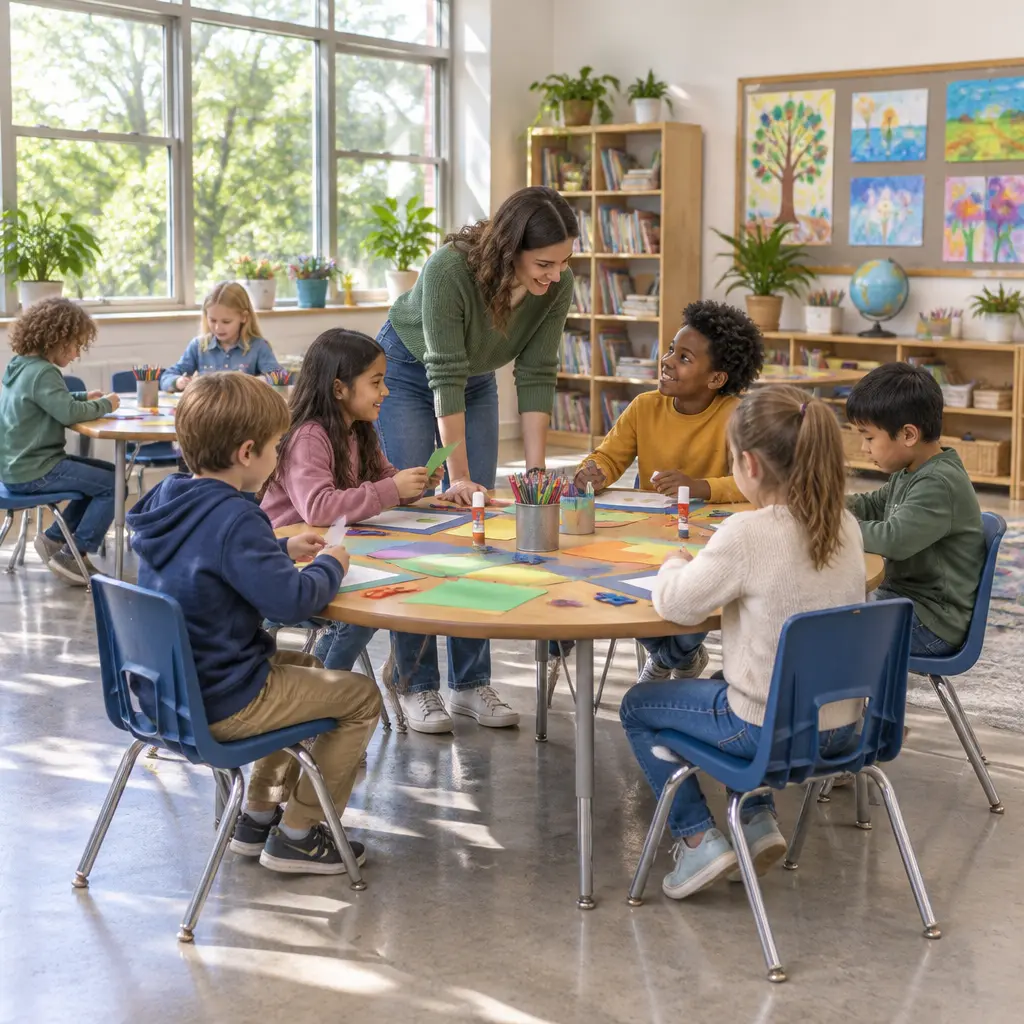
Feeling included means experiencing acceptance, respect, and a genuine sense of belonging among peers. Children who feel included are more likely to include others because supportive relationships can teach empathy, model welcoming behavior, and make prosocial actions feel safe and worthwhile. Research on belonging, peer relationships, and social-emotional learning supports this connection, although inclusion is shaped by more than one factor: family, school climate, adult modeling, and opportunities to cooperate matter too. Understanding those influences helps parents and educators build classrooms and communities where children are not only welcomed but learn to welcome others.
Belonging strengthens children’s likelihood of including others
Belonging is a child’s experience of being accepted, valued, and connected within a group. Psychologist Roy Baumeister and social psychologist Mark Leary described the need to belong as a basic human motivation: people seek lasting, positive relationships and distress when those connections are absent. For children, belonging can develop through friendships, classroom membership, team participation, and feeling recognized by trusted adults.
Inclusion is the corresponding social practice: making room for others, recognizing their contributions, and reducing barriers to participation. The two reinforce each other. When children experience kindness and acceptance, they have examples of how inclusion works and are more likely to extend similar treatment to peers. A child who feels secure in a group may also be less concerned that welcoming someone new will cost them status or friendship.
The scale of the issue makes this relevant for schools and families. The U.S. Centers for Disease Control and Prevention’s 2023 Youth Risk Behavior Survey found that 40% of U.S. high school students reported persistent feelings of sadness or hopelessness during the previous year. That statistic does not measure belonging directly, and it does not prove that exclusion causes distress; it does underscore why supportive relationships and safe school environments matter to young people’s well-being.
Peer acceptance and everyday inclusion
Peer acceptance is the degree to which classmates or other age-mates welcome and value a child. It is different from popularity: a child can be widely known or socially influential without being kind, while a less prominent child may have close, supportive friendships. Everyday inclusion includes inviting someone to join a game, listening to their ideas, sharing materials, and making sure group activities are accessible.
These small actions can create a cycle. An included child gets more chances to practice cooperation and notice how others feel; peers, in turn, receive clear signals that they are welcome. A 2015 meta-analysis by Joseph Durlak and colleagues, published in the journal Child Development, examined 213 universal school-based social and emotional learning programs involving more than 270,000 students. It found improvements in social-emotional skills, attitudes, behavior, and academic performance. The review did not test the specific claim that feeling included causes children to include others, but it supports teaching the skills that make inclusive peer relationships more likely.
Belonging, safety, and willingness to take social risks
Social safety is the expectation that a child can speak, participate, or make a mistake without humiliation or rejection. Feeling secure can make it easier to show kindness, because children are less focused on protecting themselves from social threat. This does not mean that every included child will automatically include others; children still need guidance, practice, and clear expectations.
The National Academies of Sciences, Engineering, and Medicine report The Promise of Adolescence emphasizes that relationships and social environments influence adolescent development. In practice, teachers and caregivers can support social safety by responding consistently to teasing, offering multiple ways to participate, and making respectful disagreement part of group life.
Empathy and social learning translate belonging into action
Empathy is the ability to understand or respond to another person’s feelings and perspective. It helps connect a child’s own experience of acceptance with another child’s possible experience of being left out. Social learning is the process of acquiring behaviors by observing, practicing, and receiving feedback. Together, empathy and social learning help explain how belonging may encourage inclusive behavior: children can recognize exclusion, recall what welcome felt like, and try an action that brings someone into the group.
Perspective-taking and compassionate responses
Perspective-taking means considering a situation from someone else’s point of view. It can help children notice that a peer standing alone may want an invitation, or that a classmate who communicates differently may need extra time to join a conversation. Empathy is not simply feeling sorry for someone; it can lead to practical responses such as asking what would help, listening without interrupting, or adapting a game so more children can participate.
Adults can build these habits by asking questions that invite reflection: “What might they be feeling?” and “What could make it easier for them to join?” The Collaborative for Academic, Social, and Emotional Learning identifies social awareness—including understanding others’ perspectives and empathizing with people from different backgrounds—as a core social-emotional competency. These skills are useful when children encounter differences in culture, ability, language, interests, or temperament.
Modeling, practice, and reinforcement
Children learn what inclusion looks like by watching adults and peers. A teacher who distributes speaking time fairly, learns students’ names, and addresses exclusion respectfully demonstrates concrete behavior rather than relying on a general instruction to “be nice.” Caregivers can model the same approach by including quieter family members in decisions and speaking respectfully about people who are different from them.
Practice turns an abstract value into a usable skill. Cooperative projects, rotating classroom roles, and structured partner activities give children opportunities to invite, share, negotiate, and solve problems together. The 2023 CASEL State of the Field report describes social-emotional learning as a combination of skills, relationships, and supportive environments; inclusion is more likely to take root when children have repeated opportunities to use those skills and adults reinforce them consistently.
Inclusive environments make welcoming behavior easier
An inclusive environment is one in which rules, relationships, and activities allow children with different identities and needs to participate with dignity. Individual kindness matters, but it cannot by itself overcome unfair routines, inaccessible activities, or repeated bullying. Schools and youth organizations can make inclusion more reliable by setting clear norms, responding to exclusion, and designing participation so that no child must earn basic respect.
Classroom norms and cooperative activities
Classroom norms are shared expectations for how students treat one another and take part in learning. Strong norms are specific and observable: listen when someone speaks, invite classmates into group work, and challenge ideas without insulting people. Cooperative learning can support these norms when tasks require shared contributions rather than ranking children against one another.
For example, a teacher might assign rotating roles—such as facilitator, materials organizer, and reporter—so that different students have meaningful ways to contribute. This can broaden peer contact and help children notice one another’s strengths. A chart or school climate survey can help staff track whether students report feeling respected, connected, and able to participate; those measures should be interpreted alongside observation and student feedback rather than treated as a complete picture on their own.
Bullying prevention and protection from exclusion
Bullying involves unwanted aggressive behavior, a real or perceived power imbalance, and repetition or the potential for repetition, according to the U.S. Centers for Disease Control and Prevention. It differs from a one-time disagreement, though both may need adult support. Persistent exclusion can be difficult to spot because it may involve leaving a child out of conversations or activities rather than openly attacking them.
The CDC’s 2023 Youth Risk Behavior Survey found that 19% of high school students had been bullied on school property during the previous year, while 16% had experienced electronic bullying. These self-reported figures concern high school students and should not be generalized to every age group. They nevertheless show why adults need clear reporting routes, fair follow-up, and support for both targeted students and bystanders who want to help.
Accessibility and respect for difference
Accessibility means removing barriers that prevent a child from participating. A playground activity may need an adapted rule; a group discussion may need visual instructions or extra response time; a school event may need materials available in more than one language. These adjustments communicate that participation is expected and that difference is not a reason to leave someone out.
The U.S. Department of Education’s Individuals with Disabilities Education Act guidance describes the importance of educating students with disabilities alongside nondisabled peers to the maximum extent appropriate, with supports and services considered individually. Inclusive practice is not simply placing children in the same room: it requires meaningful participation, appropriate support, and attention to each child’s needs and preferences.
Families and educators can nurture a reciprocal cycle
A reciprocal cycle begins when adults help a child feel accepted, then coach that child to offer acceptance to others. It is strengthened by consistent relationships, structured opportunities to cooperate, and thoughtful responses when exclusion occurs. The aim is not to make children responsible for fixing every social problem; adults remain accountable for creating safe conditions and addressing harmful behavior.
- Notice who participates and who is repeatedly overlooked, using observation rather than assumptions about a child’s preferences.
- Teach and rehearse simple invitations, such as “Would you like to join us?” and respectful ways to respond when someone says no.
- Use group activities that distribute meaningful roles and value different strengths.
- Ask children privately whether they feel safe, respected, and included, and follow up on what they share.
- Respond to bullying and exclusion promptly, while supporting the child affected and reinforcing clear expectations for the group.
A useful real-world example is a classroom that combines rotating group roles with regular check-ins. A student who has felt overlooked may first experience a structured invitation to contribute; with adult coaching, that student can later notice and welcome another peer. The example illustrates a plausible learning pathway, not a guaranteed outcome: children differ, and the quality of adult support and group climate matters.
Conclusion: belonging can help children become more inclusive peers
Belonging gives children connection and social safety; empathy helps them recognize what others may feel; and modeling, practice, and inclusive environments turn those insights into action. Research on social-emotional learning and youth well-being supports investing in supportive relationships, while survey findings on sadness and bullying show that many young people still face challenges. The evidence supports a practical conclusion rather than a simple guarantee: children are more likely to include others when they experience acceptance and are taught how to extend it.
Parents, educators, and youth leaders can start by asking children whether they feel they belong, noticing barriers to participation, and creating everyday chances to cooperate. Small invitations matter, but lasting change depends on adults building environments where every child can contribute with dignity.
Sources: Baumeister, Roy F., and Mark R. Leary, “The Need to Belong: Desire for Interpersonal Attachments as a Fundamental Human Motivation,” Psychological Bulletin, 1995, https://doi.org/10.1037/0033-2909.117.3.497; Centers for Disease Control and Prevention, Youth Risk Behavior Survey Data Summary & Trends Report: 2013–2023, 2024, https://www.cdc.gov/yrbs/dstr/index.html; Durlak, Joseph A., et al., “The Impact of Enhancing Students’ Social and Emotional Learning: A Meta-Analysis of School-Based Universal Interventions,” Child Development, 2011, https://doi.org/10.1111/j.1467-8624.2010.01564.x; Collaborative for Academic, Social, and Emotional Learning, What Is the CASEL Framework?, https://casel.org/fundamentals-of-sel/what-is-the-casel-framework/; National Academies of Sciences, Engineering, and Medicine, The Promise of Adolescence: Realizing Opportunity for All Youth, 2019, https://doi.org/10.17226/25388; U.S. Centers for Disease Control and Prevention, Bullying, https://www.cdc.gov/youth-violence/about/about-bullying.html; U.S. Department of Education, Individuals with Disabilities Education Act, https://sites.ed.gov/idea/